
Brow Lift in NYC

Refined brow and forehead rejuvenation designed to open the eyes, restore brow position, and refresh the upper face without a surprised or overdone look


“A brow lift should open the eyes, not change the face.”
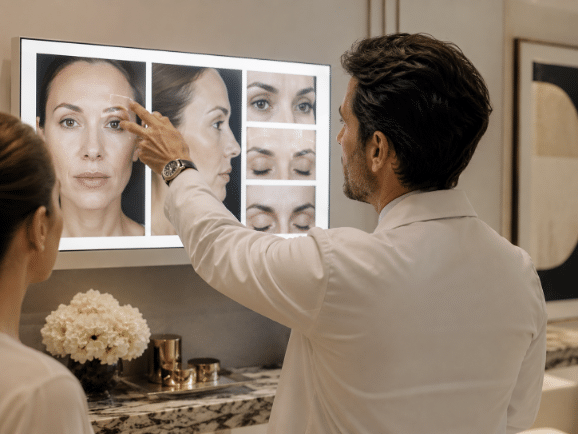
Brow lift photo

Restore brow position while preserving expression.

A brow lift addresses heaviness of the forehead and brows that can make the eyes appear tired, stern, or less open than they once did.

In many patients, the concern is not only loose upper eyelid skin, but descent of the brow itself — especially along the outer brow, where subtle drooping can crowd the upper eyelid and change the expression of the face.

Dr. William J. Rifkin approaches brow lift surgery with restraint, precision, and attention to the entire upper face. The goal is not to raise the brows as high as possible, but to restore a natural, balanced brow position that makes the eyes look brighter while preserving the patient’s identity and expression.

When the brow contributes to a tired or heavy look.

A brow lift can be helpful when brow descent contributes to a tired, heavy, or stern appearance. The goal is not simply to lift the brow higher, but to restore a more natural relationship between the forehead, brow, upper eyelids, and eyes.

Heavy or low brow position

Hooding at the outer upper eyelids

A tired, stern, or angry resting expression

Asymmetry between the brows

Deep forehead creases or frown lines

Loss of lateral brow shape or support

“The goal is not a higher brow. The goal is a better expression.”

Sometimes the eyelid is not the whole problem.

Many patients who feel they need upper eyelid surgery actually have a combination of upper eyelid skin excess and brow descent. When the brow sits too low, it can push skin downward onto the upper eyelids, making the eyes appear heavy even when eyelid skin itself is not the only issue.

Upper blepharoplasty removes excess eyelid skin. A brow lift repositions the brow and forehead tissues. In some patients, one procedure is enough. In others, the most natural result comes from combining a conservative brow lift with upper blepharoplasty to restore balance across the entire upper face.

A customized approach to brow shape, hairline, and eyelid balance.

Upper-face rejuvenation should be designed around brow position, eyelid balance, and expression. Brow lift surgery is tailored to the individual patient rather than approached as a one-size-fits-all lift.

Endoscopic Brow Lift


An endoscopic brow lift uses small incisions hidden within the hair-bearing scalp. Through these incisions, the forehead and brow tissues are carefully released and repositioned to restore a natural brow position with minimal visible scarring.

Temporal or Lateral Brow Lift


A temporal brow lift focuses on the outer portion of the brow. This can be especially helpful for lateral brow descent, outer upper eyelid hooding, or a tired appearance around the eyes.

Combined Upper-Face Rejuvenation


For many patients, brow lift surgery is planned together with upper blepharoplasty, lower blepharoplasty, facial fat grafting, laser resurfacing, or facelift surgery when appropriate.

Refreshed, not surprised.

A well-executed brow lift should not make the eyes look startled or the forehead look tight. The most elegant brow lift results are subtle: the eyes look more open, the upper lids look less crowded, and the expression appears more rested while the face still looks like you.

Rested, lifted, and natural — never startled — is the goal. Dr. Rifkin evaluates brow position in relation to eyelid shape, forehead height, hairline, facial proportions, and individual aesthetic goals. The objective is to restore support and softness while avoiding the over-elevated appearance many patients associate with older brow lift techniques.

Who may benefit from a brow lift?

You may be a candidate for brow lift surgery if you are bothered by heaviness of the forehead or brows, hooding at the outer upper eyelids, a tired or stern expression, or asymmetry of the brow position. Good candidates are generally healthy, have realistic expectations, and want a result that looks refreshed rather than obviously surgical.

During consultation, Dr. Rifkin evaluates whether your concern is primarily related to the brow, the upper eyelids, or both. This distinction is important because removing eyelid skin alone in a patient with significant brow descent can sometimes fail to fully address the heaviness.

What to expect after brow lift surgery.

Most patients experience swelling, bruising, and a feeling of tightness in the forehead or scalp during the first week. Light activity is often resumed within several days, and many patients feel socially presentable within 10 to 14 days depending on the extent of surgery and whether eyelid surgery or other procedures were performed at the same time.

The brow position continues to soften and settle over the following weeks to months. The goal is a result that looks natural at rest and with expression.

Brow Lift Questions

A brow lift addresses descent of the brow and forehead tissues, while upper blepharoplasty removes excess upper eyelid skin. Many patients have a combination of both. During consultation, Dr. Rifkin evaluates brow position, eyelid skin, facial proportions, and expression to determine which approach will create the most natural result.

Most patients have bruising and swelling for one to two weeks. Light activities may resume earlier, but final brow position and softness continue to improve over several weeks to months.

Considering brow lift surgery in New York City?

A consultation can help determine whether your concerns are best addressed with brow lift surgery, upper blepharoplasty, or a combination approach tailored to your anatomy and goals.

Contact Us

Accessibility Toolbar

Scroll to Top
