
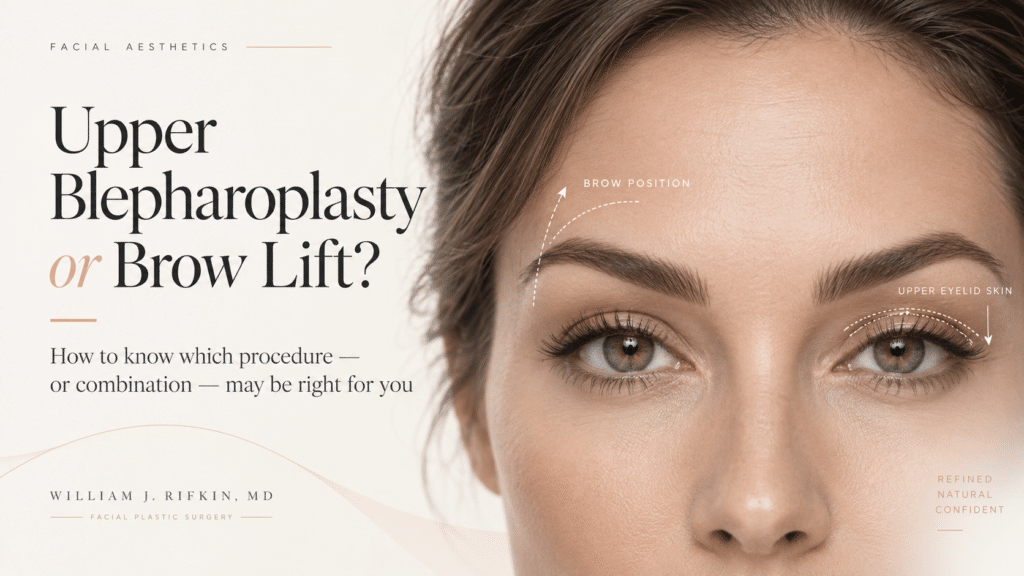
One of the most common concerns I hear from patients is that their upper eyes feel heavy, tired, or less open than they used to. It is also common for patients to assume that excess upper-eyelid skin is always the cause.
Sometimes it is. But not always.
The appearance of the upper eyelid is closely related to the position of the brow. As the brow descends over time, particularly along its outer portion, it can contribute to fullness and hooding over the upper eyelid. In other patients, the brow remains in an appropriate position and the primary issue is excess upper-eyelid skin itself.
And in many patients, both are contributing.
Understanding the difference is important because an upper blepharoplasty and a brow lift address different parts of the upper face.
What Does an Upper Blepharoplasty Address?
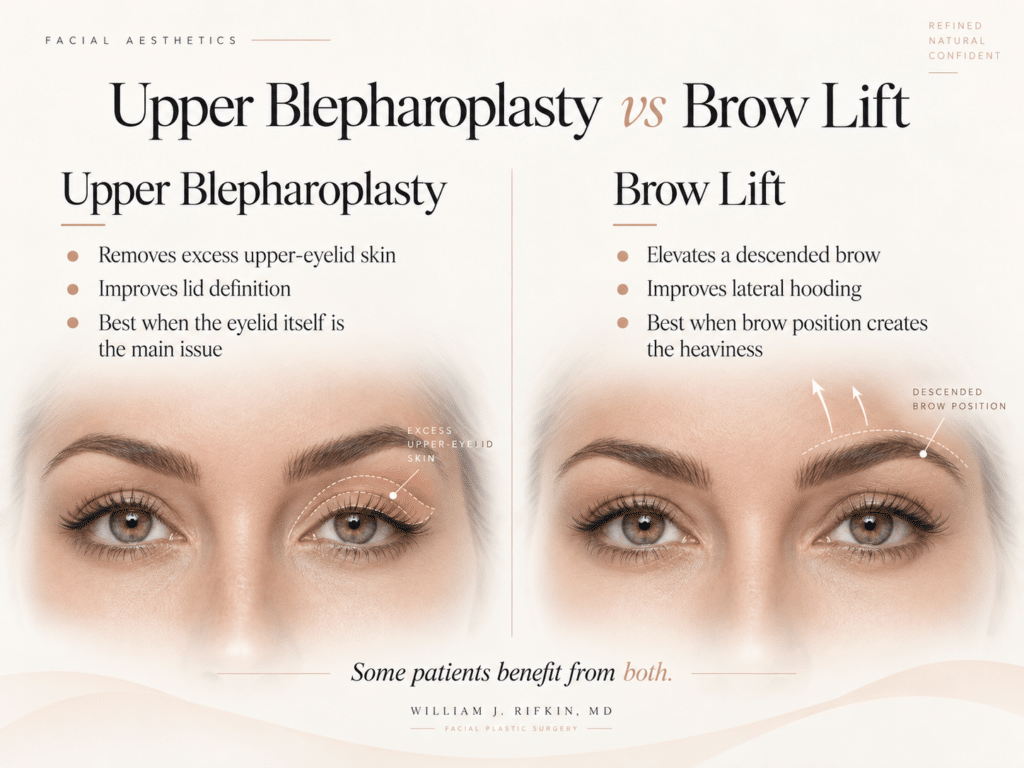
An upper blepharoplasty is designed primarily to address excess skin of the upper eyelid.
With aging, the upper-eyelid skin can become more redundant and begin to fold over the natural eyelid crease. This can make the eyes appear heavier or less defined and, in more pronounced cases, can even interfere with the visual field.
During upper blepharoplasty, excess skin is carefully removed through an incision placed within the natural upper-eyelid crease. Depending on the patient’s anatomy, small amounts of underlying fat may also be addressed.
The goal is not to create an overly hollow or operated appearance. I generally favor a conservative approach that restores definition to the upper eyelid while maintaining the natural character of the eye.
Patients whose brow position is already appropriate, but who have true excess upper-eyelid skin, may do very well with upper blepharoplasty alone.
When the Brow Is Part of the Problem
The brow and upper eyelid should not be evaluated separately.
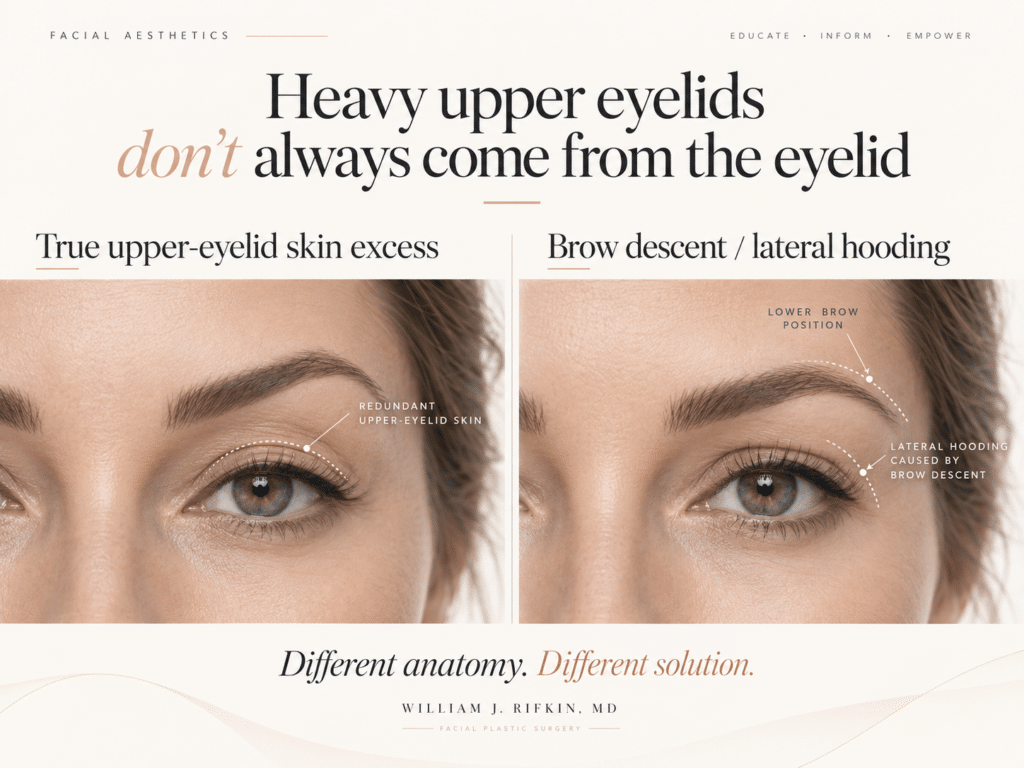
As the brow descends, it can push additional soft tissue toward the upper eyelid. This is particularly noticeable along the outer portion of the eye, where brow descent can create what is often called lateral hooding.
A patient may therefore appear to have significant excess upper-eyelid skin when part of that heaviness is actually coming from the brow above it.
This distinction matters.
If the brow is contributing significantly to the problem, simply removing more eyelid skin does not address the underlying cause. In some patients, overly aggressive removal of upper-eyelid skin can also create an unnatural appearance or limit the ability to appropriately reposition the brow later.
A brow lift addresses the brow itself by repositioning it into a more youthful and aesthetically appropriate position. The goal is not necessarily to create a dramatically elevated or surprised-looking brow. In most patients, the objective is subtle restoration of brow position, improvement in lateral hooding, and a more open appearance around the eyes.
How Do I Decide Which Procedure a Patient Needs?
This is determined during the physical examination.
When evaluating the upper face, I look at several things together:
- The amount of true excess upper-eyelid skin
- The position and shape of the brow
- The amount of lateral hooding
- The relationship between the brow and the bony orbital rim
- Eyelid crease definition
- Facial asymmetry
- How the upper eyelid changes when the brow is gently supported in a more appropriate position
That last point can be particularly helpful.
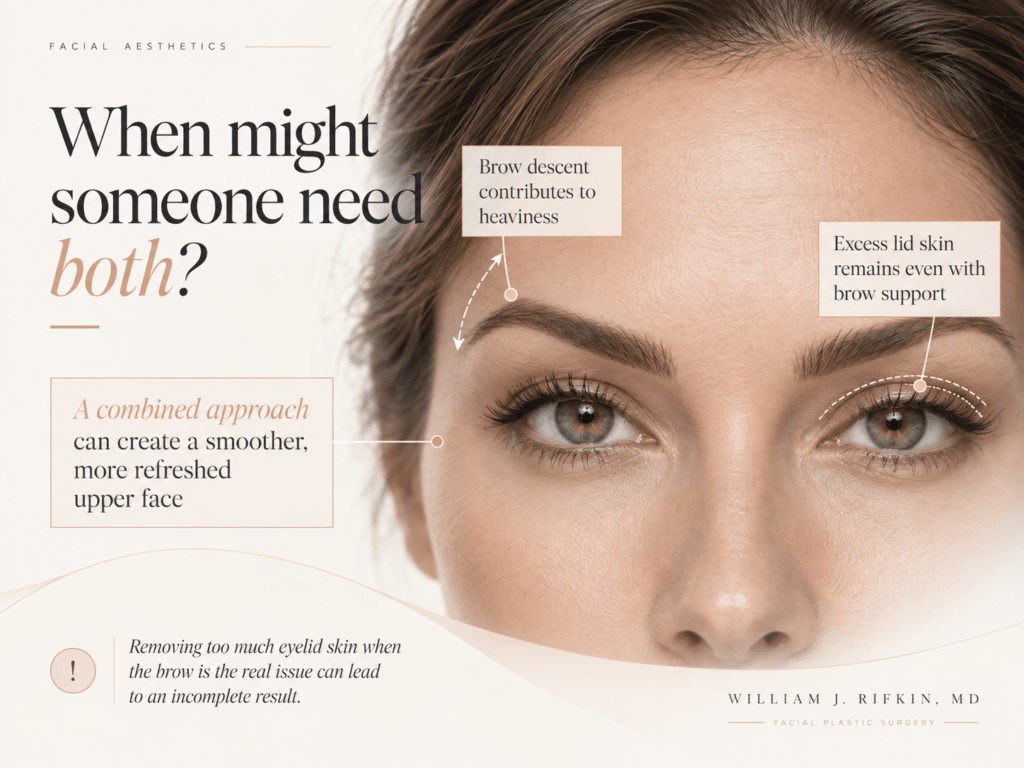
If gently repositioning the brow substantially improves the apparent eyelid heaviness, then brow descent is likely contributing to the problem. If significant redundant eyelid skin remains even after the brow is supported, an upper blepharoplasty may also be beneficial.
There is no single measurement that determines the correct procedure for every patient. The entire upper face needs to be evaluated as a unit.
Can You Need Both an Upper Blepharoplasty and a Brow Lift?
Absolutely.
In fact, some patients have two separate age-related changes occurring at the same time: the brow has descended, and the upper-eyelid skin has also become redundant.
In those patients, treating only one component may leave the other unaddressed.
A brow lift can restore the position of the brow and improve lateral hooding, while an upper blepharoplasty can address the remaining excess skin directly on the eyelid. When appropriate, combining the two can create a smoother and more balanced rejuvenation of the upper face.
The key is determining how much each structure is contributing.
Will a Brow Lift Make Me Look Surprised?
This is a common concern, and understandably so.
A well-planned brow lift should not simply pull the eyebrows upward. Brow position, shape, hairline, forehead anatomy, facial proportions, and the patient’s baseline appearance all need to be considered.
My preference is generally for a natural result that restores a more youthful position without creating an exaggerated arch or an obviously elevated brow.
Different brow-lift techniques can also be used depending on the patient’s anatomy and goals. Some patients primarily need improvement of the outer brow, while others may benefit from more comprehensive repositioning.
The technique should be selected for the individual patient rather than applying the same operation to everyone.
What If I Am Not Sure Which One I Need?
You do not need to know before your consultation.
Many patients come in convinced that they need an upper blepharoplasty and ultimately learn that brow position is playing an important role. Others are worried that they need a brow lift when a relatively straightforward upper blepharoplasty may adequately address their concern.
The purpose of the consultation is to determine which anatomical changes are actually creating the appearance you are seeing.
Sometimes that means upper blepharoplasty.
Sometimes it means a brow lift.
And sometimes the most balanced result comes from addressing both.
The Goal: A More Refreshed Version of You
Upper-face rejuvenation should not change the character of the eyes or create a different expression.
The goal is to identify what has changed over time and selectively restore those structures while preserving the features that make the face recognizable and unique.
For some patients, that means removing excess upper-eyelid skin. For others, it means restoring the position of the brow. For many, it involves carefully balancing both.
A detailed evaluation of the brow and upper eyelid together is the best way to determine which approach makes sense for you.
Considering upper eyelid or brow lift surgery?
To learn more about upper blepharoplasty, brow lift surgery, or other facial rejuvenation procedures, you can schedule a consultation with William J. Rifkin, MD in New York City.


